EU and Canada to seal future alliance against Trump pressure at Montreal summit
Brussels and Ottawa aim to deepen cooperation on trade, security, climate and artificial intelligence as transatlantic trade passes 131 billion euros.
KEY POINTS
- EU and Canada hold a Montreal summit to seal a new “Alliance for the Future”
- Partnership would cover climate, energy, AI, innovation, security and the Arctic
- Expected digital trade deal would complement the 2016 CETA treaty
- Transatlantic trade reached 131 billion euros in 2025, up 80 percent
- Canadian officials reject associated EU membership and free movement of workers
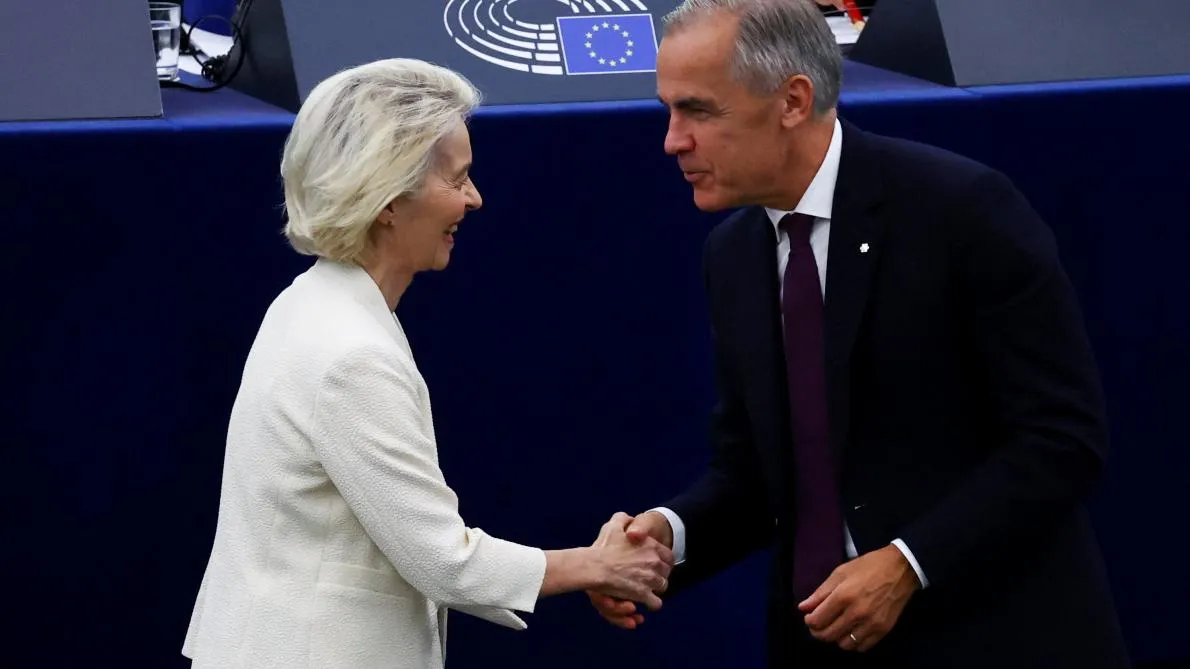
European Union and Canadian leaders are meeting in Montreal on Thursday and Friday for a summit described by a senior Commission official as probably one of the most important the EU has ever organized. The two sides want to seal a new “Alliance for the Future” to defend democracy, human rights, the rule of law and the rules-based international order.
The alliance is intended to become the EU’s closest partnership with a third country, covering climate, energy, artificial intelligence, innovation, security and the Arctic. A senior Commission official said the world must have the courage to think outside conventional paths during this period of brutalized international relations.
“The power does not belong only to the strongest, the richest or the loudest.”
One concrete announcement expected at the summit is a digital trade liberalization agreement to complement the CETA treaty signed in 2016. CETA faced opposition from Wallonia and has not yet been ratified by ten member states, including Belgium, which still lacks approval from the Brussels parliament. Its commercial provisions nevertheless entered into force in 2017.
Trade between the two sides of the Atlantic has risen by 80 percent since then, reaching 131 billion euros in 2025. The summit takes place just over a month after Canadian Prime Minister Mark Carney addressed the European Parliament and called for closer ties between Canada and the bloc’s 27 countries.
European Commission President Ursula von der Leyen previously suggested Canada could become the EU’s first “associated member,” but Canadian officials quickly downplayed that possibility. Canada’s ambassador to the EU, Jonathan Wilkinson, said Carney had instead spoken of an “alliance for the future” after von der Leyen’s speech.
Canadian Conservative Party leader Pierre Poilievre insisted Canada would never become an EU member state, citing opposition to EU taxes, laws and uncontrolled European immigration policy. Prime Minister Carney said any agreement would be debated and put to a vote in the Canadian Parliament.
Wilkinson also told La Presse Canadienne that the two sides are not discussing free movement of workers between Canada and Europe. Instead, they are interested in specific sectors that could benefit from a shared labor pool, including Canada’s possible participation in the Erasmus+ study and training program.
7 more sources below
COMMENTS (0)
No comments yet. Be the first.
RELATED STORIES
Democrats Release Epstein Report Targeting Trump Before Midterms
House Democrats released a report alleging the Justice Department helped cover up Jeffrey Epstein’s ties to Donald Trump ahead of the 2026 midterm elections.

Republic Day celebrations planned in Edirne and Isparta for October 29
Two Turkish cities mark the 103rd anniversary of the Republic with lantern parades and concerts.

Police Conduct Security Checks in Ankara for Turkic States Summit
Police teams carried out public order and traffic checks in Ankara as part of security measures for the 13th Summit of Heads of State and Government of the Organization of Turkic States.
- Trump Jr. Hunted in Mongolia With Kremlin-Linked Boxing Chief Who Funded Wedding
- O'Keefe and Higby face felony charges for unlawful voting in Minnesota primary
- Interior Minister warns of heavy thunderstorms across Turkey on Thursday
- Turkish President Erdoğan Welcomes Kazakh President Tokayev with Ceremony
- B.C. appeals court upholds 13-month jail sentence for Armstrong fast-food manager convicted of sexually exploiting teenage employee
This page was compiled with AI assistance from the outlets named above and passed an automated language check before publication. Montegre has no reporters of its own; the byline names the outlets the story was compiled from. Method and editorial standards