BepiColombo spacecraft to enter Mercury orbit after eight-year journey
The European-Japanese mission will attempt a critical 37-minute braking maneuver on Saturday to become only the second spacecraft to orbit Mercury.
KEY POINTS
- BepiColombo will attempt a 37-minute orbit insertion maneuver around Mercury on November 21, 2026
- The mission is a joint project of ESA and JAXA and launched in October 2018
- The spacecraft traveled nearly 10 billion kilometers using one Earth, two Venus, and six Mercury flybys
- It will be only the second spacecraft to orbit Mercury after NASA's Messenger in 2011
- No other Mercury mission is planned until at least 2035
The BepiColombo spacecraft is set to enter orbit around Mercury after eight years in space and a journey of nearly 10 billion kilometers. The European-Japanese mission will attempt its most critical maneuver on Saturday, November 21, 2026, at 20:24 Greece time.
The 37-minute braking burn will begin as the spacecraft approaches Mercury from its night side above the south pole. Four chemical thrusters will fire continuously to slow the craft enough to be captured in an initial elliptical orbit measuring 590 by 11,640 kilometers. Without a backup engine and with no second chance, an insufficient slowdown would cause the spacecraft to simply fly past the planet.
“I think it is a somewhat neglected planet of the inner Solar System, but that is one of the reasons that make it so fascinating.”
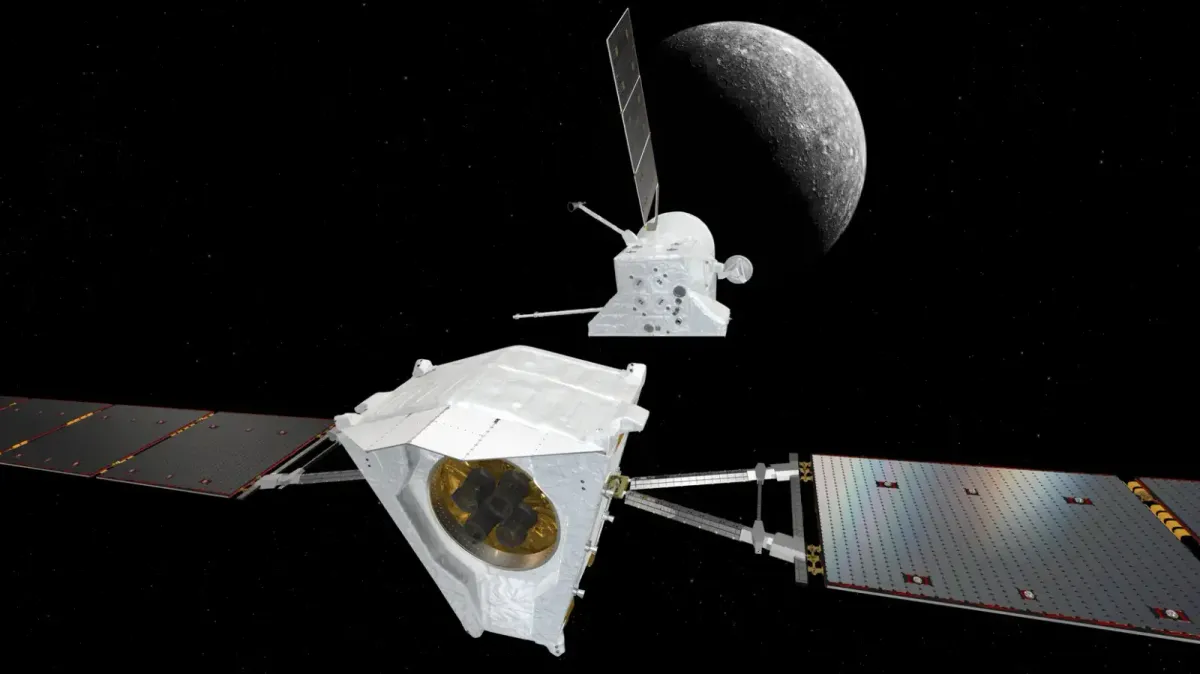
BepiColombo consists of two separate scientific spacecraft connected in a single assembly, operated by the European Space Agency (ESA) and the Japan Aerospace Exploration Agency (JAXA). The mission aims to map Mercury's surface and decode its magnetic field, and it will be only the second mission in history to orbit the innermost planet after NASA's Messenger in 2011.
The journey began on October 20, 2018, with a launch aboard an Ariane 5 rocket from Kourou in French Guiana. To counter the Sun's strong gravity, which constantly accelerates the spacecraft, BepiColombo performed one Earth flyby, two Venus flybys, and six Mercury flybys, combined with continuous ion engine operation. The trip was originally planned to last seven years, but a propulsion system problem caused a one-year delay.
Scientists hope to understand how Mercury formed, evolved, and interacts with the Sun and extreme space weather. Surface temperatures can reach 430 degrees Celsius by day and drop to minus 180 degrees Celsius at night. Professor Emma Bunce of the University of Leicester, the mission's lead researcher, called Mercury a somewhat neglected planet of the inner Solar System.
No other Mercury mission is planned at least until 2035, making this a unique opportunity for the current generation of scientists. If successful, BepiColombo will begin studying a planet that remains largely unexplored despite its proximity to Earth on cosmic scales.
2 more sources below
COMMENTS (0)
No comments yet. Be the first.
RELATED STORIES

Zucman hosts Paris summit calling for global tax on billionaires
French economist Gabriel Zucman gathers politicians and Nobel laureates in Paris to push a minimum tax on the largest fortunes and new rules for artificial intelligence.

Tamil Nadu dismisses 15 investment officials amid data leak claims to Andhra Pradesh
Guidance Tamil Nadu says employee departures were normal attrition, while former staff deny being sacked for leaking data.

EU Plans 3% Digital Tax on Big Tech to Fund 2028-2034 Budget
European Council President Antonio Costa proposes a digital levy to raise about €5 billion annually and revive stalled budget talks.
- Google rejects UK request to remove Russell Brand jail video
- EU Budget Chief Proposes €44 Billion Cut to Seven-Year Plan
- Spain Approves Decree to Boost Tech Sovereignty with 20 Research Centers
- US shoppers stockpile supplies amid fears of global tech blackout
- Istanbul's New Gaziosmanpaşa Justice Palace Opens with 29 Floors
This page was compiled with AI assistance from the outlets named above and passed an automated language check before publication. Montegre has no reporters of its own; the byline names the outlets the story was compiled from. Method and editorial standards