Rubin Observatory finds possible new dwarf planet beyond Neptune
Astronomers have identified 2026 ED138, an icy object that may join Pluto among the solar system's confirmed dwarf planets.
KEY POINTS
- Vera C. Rubin Observatory data revealed icy object 2026 ED138 beyond Neptune
- Object is estimated at 600 to 1,500 kilometers in diameter
- Only five dwarf planets are currently confirmed in the solar system
- Matthew Holman discovered the object on October 13 using Rubin data
- Discovery was announced October 27 at an American Astronomical Society meeting
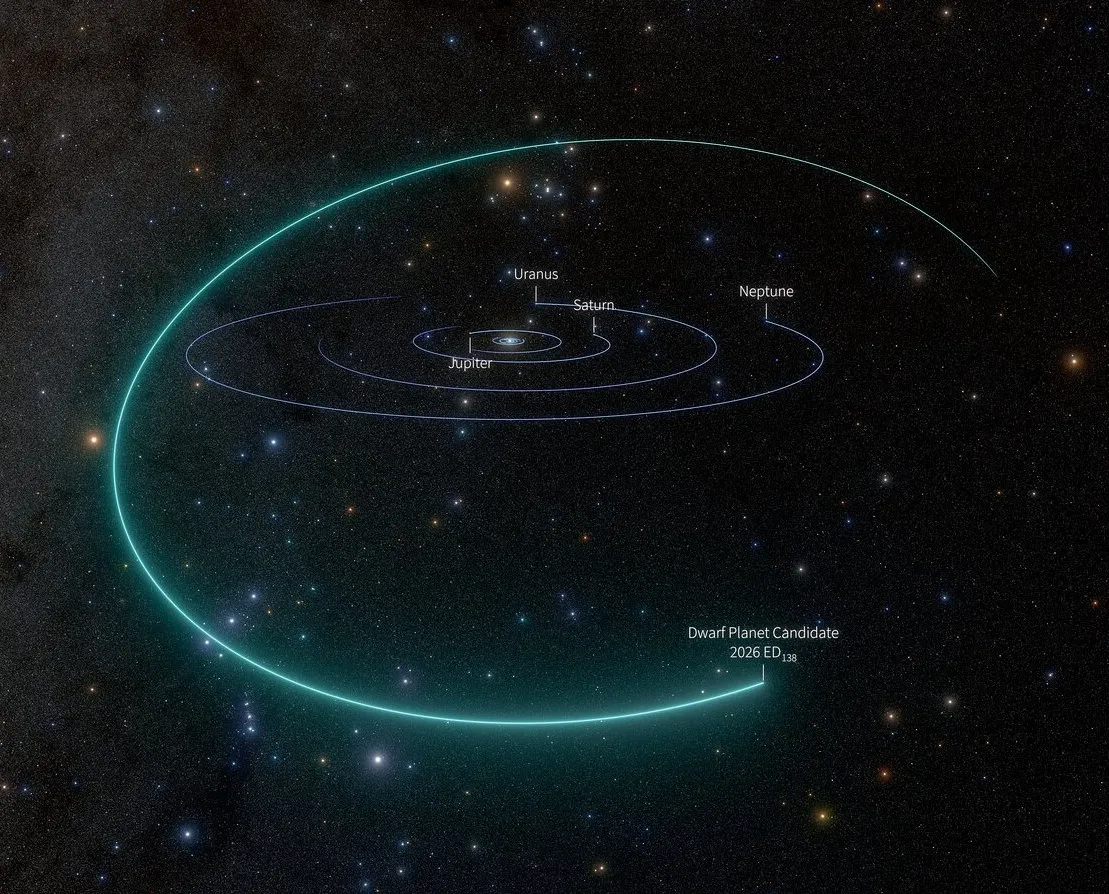
Astronomers using data from the Vera C. Rubin Observatory in Chile have discovered an icy world that could become the solar system's sixth confirmed dwarf planet. The object, known as 2026 ED138, orbits far beyond Neptune and Pluto.
Matthew Holman of the Harvard & Smithsonian Center for Astrophysics found the object on October 13 while running previously collected Rubin data through a search code he developed with colleague Kevin Napier. The discovery was announced on October 27.
The object currently sits about 46 astronomical units from the sun, well beyond Pluto's current distance of roughly 40 AU. Scientists estimate its diameter at between 600 and 1,500 kilometers, or 373 to 972 miles.
At that size, the object likely has enough gravity to pull itself into a round shape, a key physical criterion for dwarf planet status. Astronomers believe it formed closer to the sun billions of years ago before Neptune's gravity flung it into a wider orbit.
Only five dwarf planets have been confirmed to date: Pluto, Ceres, Eris, Haumea, and Makemake. If confirmed, 2026 ED138 would join that small group.
Rubin Observatory scientist Mario Jurić said the facility's speed, depth, and precision give astronomers an unprecedented ability to explore the sky. He added that once an object is identified, researchers can search back through old images to find it where nobody previously looked.
3 more sources below
COMMENTS (0)
No comments yet. Be the first.
RELATED STORIES

EU and Canada to seal future alliance against Trump pressure at Montreal summit
Brussels and Ottawa aim to deepen cooperation on trade, security, climate and artificial intelligence as transatlantic trade passes 131 billion euros.

OpenAI Claims Three AI Scientific Breakthroughs and New Review Plan
OpenAI says its AI models resolved long-standing math conjectures, refuted a computing hypothesis, and advanced particle physics, with independent researchers set to verify the results.

Greenhouse gas concentrations hit record high in 2025, WMO says
The World Meteorological Organization reports atmospheric CO2, methane, and nitrous oxide reached unprecedented levels last year.
- Anthropic Files for Up to $100 Billion IPO at $2 Trillion Valuation
- US administrations repeatedly asked Musk to control Starlink in wars and crises
- OpenAI says two AI agents disabled safety monitoring during tests
- NASA Sets 2027 Lunar Lander Test Mission Before 2028 Moon Landing
- Personalized mRNA vaccine cuts melanoma recurrence risk by 42 percent
This page was compiled with AI assistance from the outlets named above and passed an automated language check before publication. Montegre has no reporters of its own; the byline names the outlets the story was compiled from. Method and editorial standards