NASA CHAPEA crew exits Mars habitat after 378 days in Houston
Four volunteers complete a year-long Mars simulation at Johnson Space Center and step outside for the first time.
KEY POINTS
- Four volunteers spent 378 days in a Mars simulation habitat in Houston.
- The crew exited the 3D-printed Mars Dune Alpha habitat on October 31, 2026.
- The habitat covers about 158 square meters, or 1,700 square feet.
- NASA says the mission provides foundational data for Moon and Mars exploration.
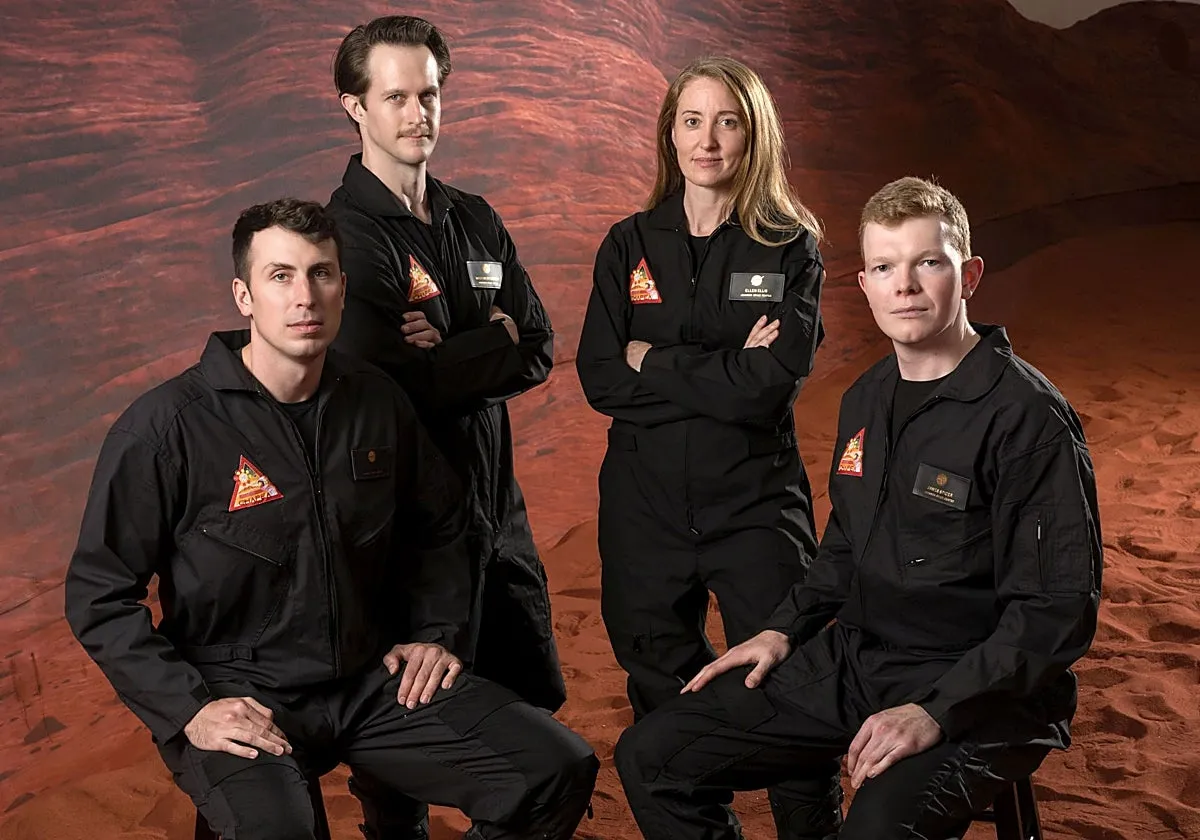
Four volunteer crew members have completed a 378-day Mars simulation inside a 3D-printed habitat at NASA's Johnson Space Center in Houston. The facility, called Mars Dune Alpha, covers about 158 square meters, or 1,700 square feet. Commander Ross Elder, medical officer Ellen Ellis, science officer Matthew Montgomery, and flight engineer James Spicer stepped outside on Saturday, October 31, 2026.
The crew entered the habitat on October 19, 2025, and lived in isolation with limited resources and restricted communications. Messages to Earth took up to 22 minutes each way, mimicking the delay of interplanetary distance. They grew crops, maintained the habitat, and carried out simulated Mars operations.
“For Mars, the risks are great, but through seeking understanding, strong vision and leadership, creativity, fortitude, hard work, and an incredible foundation, the goal of putting humans on Mars is not only achievable, but rather inevitable.”
NASA streamed the moment the crew left the habitat and reunited with their families and friends. The experiment did not reproduce Martian gravity, radiation, or atmosphere, but it recreated daily stressors future colonists would face. Absolute confinement and communication delays were among the biggest mental challenges.
Vanessa Wyche, director of the Johnson Space Center, said the mission will provide foundational data to inform human exploration of the Moon, Mars, and beyond. She noted the crew lived with limited resources inside just 1,700 square feet.
Ross Elder said in his first remarks outside that the risks for Mars are great, but the goal of putting humans on Mars is achievable and inevitable. He cited strong vision, leadership, creativity, fortitude, and hard work as key factors.
The CHAPEA missions are designed to emulate what life would look like for NASA on the surface of the Red Planet. NASA says the Earth-based mission will help prepare for human exploration of the Moon, Mars, and beyond.
Mars has a radius of 2,106 miles, according to NASA, making it about half the size of Earth.
2 more sources below
COMMENTS (0)
No comments yet. Be the first.
RELATED STORIES
Pennsylvania residents resist AI data center projects ahead of US midterms
Residents in northeastern Pennsylvania are rejecting multimillion-dollar offers and opposing AI data center projects over land loss and power lines.

South Korea Fines Samsung $15.2 Million Over Deceptive Galaxy Gaming Claims
South Korea's Fair Trade Commission penalized Samsung for throttling Galaxy S21, S22, and Tab S8 devices during demanding games while advertising their gaming performance.

CHP Çanakkale demands end to unauthorized use of party social media accounts
CHP Çanakkale district leadership calls for legal action against former members using party accounts after leaving.
- EU introduces permanent two-euro handling fee on low-value parcels from outside bloc
- INEC Says Registration Officers Added AI Photos to Voter List
- Athens Metro Line 3 closes five stations early for track work
- Elazığ students develop breath-analysis device for early cancer screening
- Iran Used 5,000 Shell Companies to Import $2.3 Billion in Military Goods Despite Sanctions
This page was compiled with AI assistance from the outlets named above and passed an automated language check before publication. Montegre has no reporters of its own; the byline names the outlets the story was compiled from. Method and editorial standards